Anytime I’m awake, there is nearly always a little person in my mind doing a verbal play-by-play, talking about a problem I’ve been trying to solve, or just rambling on about something unimportant. I think of it as The Narrator of my life, even though it’s not entirely trustworthy and doesn’t like to stay on topic.
If you are reading this, you fall into one of two categories: you completely understand that previous paragraph or you think it sounds absurd.
If you have a Narrator, you might be surprised to find out there are people who don’t have one. Like, a lot of them. And the idea that someone might not have one leaves you wondering how Narrator-less people work anything out.
If you don’t have one, you may wonder how anyone can get anything done with a tiny voice inside their head that only sometimes wants to talk about what they’re working on?
While I don’t know what it’s like to live without a Narrator, having one can sometimes be very useful. I’ll be mowing the lawn, and The Narrator finally figures out the best way to solve a problem I’ve been having with a particular piece of code. But other times, when I really need to focus on something, all it wants to talk about is the time seven years ago when the grocery store cashier said, “thank you,” and I responded with “you too,” and I wanted to crawl into a hole and spend the rest of my life there.
For me, the worst time to have my inner monologue go rogue is when I wake up in the middle of the night and can’t stop thinking about what classifies as a sandwich.
You’ve probably seen The Sandwich Alignment Chart. You may even have strong opinions about it. Many do. But thanks to The Narrator and our conversations at 3:58 AM, I’ve figured a few things out.
I’m a sandwich purist. Bread, protein, optional toppings, bread. Designed to be eaten with one or more hands in a landscape orientation and, if necessary, while on the move. That’s how it was, how it is, and how it always shall be.
The open-faced sandwich? Not a sandwich. Without the top piece of bread, any self-respecting, open-faced “sandwich” is nearly impossible to pick up to eat without making a mess of things. So, how should it be classified?
It depends on the size. If it is of small size, a “finger-food, open-faced sandwich,” if you will, it’s an hors d’oeuvre. Think cheese and pepperoni on a cracker. Clearly an hors d’oeuvre.
If it’s large, it’s a pie. Yes, a pie. You probably think I’ve gone around the twist on this one, but hear me out. Make a spectrum on a line, with one end being a peanut butter sandwich (clearly and inarguably a sandwich) and on the other end, a shepherd’s pie (clearly not a sandwich). Now, figure out where you would put an open-face roast beef sandwich on that line. If you’re being honest with yourself, it’s far more closely related to the shepherd’s pie.
The Taco? Not a sandwich. The taco fails the sandwich test on two measures. First, it’s designed to be eaten vertically. Get yourself a peanut butter sandwich and try to eat that thing rotated 90 degrees from how you made it. It’s damn near impossible without squishing the thing into oblivion. Secondly, there’s the bread problem. (If you even want to classify the taco shell as bread. I have strong opinions there, too, but those aren’t required to prove that a taco isn’t a sandwich.) The shell wraps around the bottom, so, by design, not a sandwich.
“Ah yes,” you say. “What about the hot dog?” The same arguments I’ve used to eliminate the taco as a sandwich are true for the hot dog: eaten vertically with bread wrapped around the bottom. The answer, however, is simple. The hot dog isn’t a sandwich.
It’s a taco.
“Now I’ve got you!” you think. “What about the Subway-style sub sandwich?” (Or, for that matter, the single-slice folded in half sandwich.) While it is true that this style is designed to be eaten vertically, it gets a special dispensation applied since, while intended to be eaten vertically, it still has a defined top and bottom that puts the bread above and below the good stuff when you set it down.
“So does a hot dog!” you say. But you’re not taking into account what I like to call the “Catastrophic Failure Rule,” which states that a sandwich must either be impervious to the protein and toppings falling out of the sandwich (or can still be reasonably eaten without undue measures) in the event of a catastrophic failure of the bread. (The Catastrophic Failure Rule is a natural extension of the sandwich’s ability to be eaten on the run.)
Any well-constructed, Subway-style sub sandwich can withstand the failure of the bread connecting the two sides. If the bottom falls out of your taco, you’ve got a problem, and this helps strengthen my case on the hot dog not being a sandwich. Who hasn’t had the bottom fall out of their hot dog and wound up with a mess on their hands? And their plate. And probably their lap, too. Ergo, the hot dog is not a sandwich.
The hot dog is a taco.
Also, what is it like not to think about the definition of a sandwich at 3:58 AM when all you really want to do is fall back into a peaceful slumber?
If you’re not hashtag very online, a Blue Jackets fan podcast committed some Jacket-on-Jacket crime. They made an offhanded joke demeaning the mental health of a CBJ player currently in the NHL’s Player Assistance Program, and the fanbase (and hockey community in general) found that pretty offensive and did their best to condemn the remark and support the player.
If that doesn’t ring a bell, a quick search on the Twitter dot com will fill in the gaps.
Mental health is something close to my heart because I’ve struggled with depression off and on for most of my adult life. If I’m being completely honest with myself, it’s been my whole life; it just wasn’t diagnosed until college.
If you know me and didn’t know this, it’s probably a pretty big surprise to you. Socially, I project a happy demeanor, believing there are only a few situations where trying to make someone laugh is a bad idea.
Some of that is masking; the disease makes you feel like you’re burdening others, and so I hide. Sometimes, it’s genuine happiness; depression can come and go, and when I have it under control, I am genuinely a pretty positive and happy person.
Occasionally, it’s somewhere in between, a sort of “fake it ’till you make it” approach to mental stability. That’s frequently not effective. Sometimes it is.
Twitter did two things after the video became widely circulated (even being seen and commented on by Patrik Laine, the target of the “joke”). People raged and called it (accurately) unacceptable and abhorrent. People also started donating to the mental health initiative Laine himself champions. I happily chipped in.
The second of those reactions is a beautiful outcome from a horrible situation. The first was something else entirely.
Let me be clear: the comment was out of hand, disgusting, horrible, no-good, and any other adjective you can think of. It has no place in civilized society, let alone in hockey, and deserves to be called out as such.
But the people that made it are human.
People rushed to complain about the unacceptable Notes App apology they were looking forward to, only to later complain about the video apology that was also deemed unacceptable.
I don’t know if the apology was good enough. I’m not the one they owed an apology to.
What I can tell you is that it was objectively clear in that video that they knew they had screwed up on a massive level. Their podcast is likely over. They’ll be easily recognized if they go to the Arena District, and, given some of the horrible reactions, I’m sure they won’t be comfortable. Their public fandom of the Blue Jackets will never be the same again.
And. They. Knew. It.
Folks piled on, saying they were apologizing only to try to do damage control and that they were not really sorry. For me, the reason doesn’t even matter. They could have played the heel and continued to make inappropriate comments to gain attention, but they didn’t.
They realized the gravity of one line done in poor taste to get a chuckle, a line that could have been edited out of the not live podcast, and they issued an apology. With any luck, they’ve grown up a little bit in this experience and will never verbally joke about mental health no matter what is in their heart. Knowing what you simply can’t say is a step in the right direction, even if they aren’t sorry.
As for me, things are going pretty good right now. My depression and anxiety are largely under control. Many others out there today are not so lucky.
If their hearts are indeed where they say they are, the gentlemen on this podcast are having a rough time right now, and their mental health also matters. Even if the words in their apology video are not how they truly feel, and they’re just doing it to stem the flood of outrage, they still deserve our grace and kindness.
The US Suicide and Crisis Lifeline is 988. It provides 24-hour support to anyone in a suicidal crisis or emotional distress. Calling or texting 988 will connect you with a trained crisis counselor.
If you regularly (or irregularly) see a doctor, talk to them. They’ll point you in the right direction.
Or, just reach out to a friend or family member, even if it’s uncomfortable and you feel like you’re being a burden. That’s the disease talking. I can damn near guarantee you that they’re already worried about you but don’t know how to start the conversation.
Today is someone’s worst day of their life, and you never know who that person is. Treat everyone with kindness.
The usually quiet Prime Minister emerged from a green warp pipe that’s commonly seen in Mario games – as well as in the animated presentation that tied into his appearance, shown on the screens in the stadium.
We spend so much of our time focused on how different we all are. We speak different languages. We practice different religions. We are from such different places.
You don’t have to look very far when watching the Olympics to find someone who is very different from you. They were born in Bulgaria, China, and Kenya. They escaped war-torn Eritrea with their family as a child. They come in every skin tone from the darkest ebony to the lightest ivory, and have names like Enkelejda Shehaj, Nana Fa’avesi, and Kanak Jha. Tattoo. Piercing. Hijab.
And that’s just on Team USA.
The thing is, you don’t have to look very far to find someone exactly like you, either. There’s 19-year old Simone Biles, who I’m convinced one day is going to make the transition from figurative to literal flying, and no one is going to be surprised. Or cyclist Kristin Armstrong, who turned 43 the day after crossing the finish line in the time trial, asking simply “Did I win?” and collapsing in exhaustion.
Maybe the Fiji Men’s Rugby Sevens team is more like you. Forget their homes: some of their home towns don’t even have electricity.
Or Sarah Robles, who joked after the competition that the reason she yells before each lift is to drown out all the voices in her head. While you might not be a weightlifter, you probably have those voices, too. I know I do. They tell her that she can’t do what she’s about to do. She yells, knowing that when the voice on the outside is louder than all the ones on the inside, she can do it.
Possibly Abbey D’Agostino, who encouraged Nikki Hamblin to get up and finish their 5,000 meter race after the two got tangled up, only to have Hamblin return the favor a few moments later, when D’Agostino realized just how injured her knee really was.
How about Fu Yuanhui, the swimmer that didn’t know she had won the bronze metal until the reporter told her halfway through this interview? That’s worth a second look, or a first one if you haven’t seen it yet. This video starts right after she found out.
That very likely wasn’t in a language you speak. It doesn’t need to be. She just like you.
Monica Puig. Mo Farah. Ibtihaj Muhammad. Usain Bolt. Katie Ledecky. Zahra Nemati. Meb Keflezighi. People just like you and me. Even when they are nothing like you and me.
Later this evening, a crier will walk on stage in Rio, and call upon the youth of the world to assemble in four years. All of us grown ups will go back to focusing on how different we all are.
Meanwhile, the youth of the world will look on in wonder, and think that assembling in four years sounds like fantastic idea. They will start dreaming of being the next fencer, or judoka, or master of any other sport that, three weeks ago, they may not have even knew existed. All because they saw someone competing at the highest level, sometimes winning, sometimes losing. Sometimes winning even while they are losing.
Someone exactly like them, even when they were completely different.
I don’t use Strava, and it looks like more people use it for biking than running, but this is interesting. A heat map of where people all over bike and/or run, making it easy to find new places to exercise.
100 million rides and runs, 220 billion data points visualizing the best roads and trails worldwide.
I hate running in the cold. Can’t stand it. I would rather run when it’s 100° outside and 90% humidity, with sweat in my eyes and a grimace on my face. I’ll take the heat, and you can have the cold. Hate hate hate. (I’m using the word hate here about running in the cold.)
The only problem is, I love running in the snow.
First off, it’s just pretty. Everything has a little white toupee on it. Except the ground, of course, which has on a big white blanket. Everything looks familiar, but strange. If you have right running spot, or are really eager, you get to be the first person putting down tracks.
And it’s hard work. Every step is an adventure, because you’re just always a second away from having your feet slide out from under you, and if the snow is a little crusty, you never know just how far your foot is going to sink into it before it finds something solid to push-off on. In that way, it’s like running on a sandy beach. (In every other way, it’s exactly not like running on the beach.) With every step being a struggle just to stay vertical, snow makes you check your pace-minding lizard brain’s ego and focus on the effort.
Today was a great day to start training for the year, because it was about 40º outside, so close to being warm enough to wear shorts, and there was a nice layer of snow covering the old railroad tracks between Barnesville and Baileys Mills. I knew I wouldn’t be the first set of tracks, but there wouldn’t be many.
Out the door, and into the woods.
The plan was to take a six-mile run, with the three out miles (all of which are downhill) being at a leisurely pace, and the three in miles (all uphill, naturally) at a half marathon effort. Plans changed quickly, though, when the ‘leisurely’ pace of 10:15 for the first mile had me puffing like steam engine. Four inches of crusty snow were having its way with me. Egos were checked, executive decisions were made, and the out section became the hard effort portion, finished at an average pace of 10:31 and feeling hard-worked, but great. No problem, turn around, and ease your way home.
Mile four? 13:08 and swearing off running for the rest of my life. Mile five? 13:38 and wondering if this hill is ever going to end. Mile six checked in at a trudging 14:06, for a section average of 13:37, and an overall run average of 12:04. Legs ached, lungs burned, and despite my best efforts, egos were a bit bruised.
But running is like that, sometimes. “Man, it feels so good to be training again!” can quickly turn into “what in the name of everything holy am I doing?” You keep pushing, you keep grinding, and you keep looking for the little wins. Today, that win came in looking back to the first training session of last year.
February 4th, 2014: 5 miles, 12:08 average pace. A mile shorter, and four seconds per mile slower, than today’s run. And just like that, it suddenly felt good to be training again.
I’m still getting together my racing schedule for the year, but I know that I’m going to do the Ogden Half Marathon Classic in Wheeling, West Virginia again this year. The 29th Street Hill is a bit like fighting a kraken: it is a two-mile, 600-foot climb that never seems to end. (Seriously, go over to halfmarathon.net and check out the elevation profile. It’s a monster.) To say that the climb absolutely stinks is like saying that a giraffe is a bit tall, but the crowd at the top in Bethlehem makes it worth while. Those people are awesome.
I’m also planning on tackling the Columbus Marathon again in the fall. Arch City kicked me squarely in the hindquarters last year, and yet it was such an amazing experience that I still haven’t been able to put it into words. Maybe some day.
This year for Christmas I thought I’d take a swing at a Columbus hopped Christmas IPA, flavored with walnut infused bourbon, cinnamon, and nutmeg. With any luck, they’ll be ready just in time for the family Christmas party. Here’s the recipe.
Ingredients
Grain Bill
4 pounds 2-row
2 pounds, 8 ounces Crystal 20L
8 ounces Red Wheat
Yeast
White Labs WLP001 California Ale
Hops
1 ounce Columbus
Other Ingredients
2 cinnamon sticks
¼ teaspoon nutmeg
1 Whirlfloc tablet
1 cup walnuts
2 cups bourbon
Preparation
Place walnuts into a clean jar, cover with the bourbon, and seal. Set aside for bottling.
Mash & Sparge
Bring 14 quarts of strike water to 163º F. Mash all grains for 60 minutes at 153º F. First runnings will be approximately 11 quarts. Sparge with 7 quarts for 20 minutes at 163º F. Total pre-boil volume will be 4 ½ gallons.
Boil
Boil for 60 minutes following this addition schedule:
60 minutes remaining: ⅓ ounce Columbus hops
20 minutes remaining: ⅓ ounce Columbus hops
15 minutes remaining: 1 Whirlfloc tablet
1 minute remaining: ⅓ ounce Columbus hops
Cool, Test & Pitch
Cool wort to 75º F, take OG measurement, and pitch yeast. Final volume should be 3 gallons.
Fermentation
Date
Gravity
Notes
11/09/2014
1.061
72% efficiency
11/16/2014
1.018
Racked to secondary
12/7/2014
1.016
Secondary Complete. 5.6% ABV
Bottling
Additional Ingredients
¾ tablespoon ground cinnamon
⅓ cup priming sugar
⅓ cup water
Strain the bourbon through a fine mesh filter and into a medium sauce pan. Add ground cinnamon, priming sugar, and water. Boil and cool to 70º F. Mix in with beer and bottle.
Up until today, I had never taken an ice bath. They seemed so, well, cold. So what if they help you recover? They are cold. All that ice bath abstaining ended today.
Next Saturday I’m running in the Parkersburg Half Marathon. So this week, to give myself a bit of rest in general and as a taper for the half marathon, I’m taking a slight break in my training for the Columbus Marathon, dropping my mileage a bit and letting the legs get rested. But, as the week wore on, my legs didn’t seem to be feeling much better than typical. In fact, they felt heavier than usual the longer the runs went on. Time for drastic measures.
As far as I can tell from my short experience, ice baths have five unique stages:
The ‘Good Idea’ Stage: From the time you decide to take an ice bath until the point where you sit down in the ice bath, freezing your keister off sounds like it might be something you want to do. So you dump a freezer full of ice into the tub, fill it halfway up with water, and sit down.
The ‘Bad Words’ Stage: If sitting down in a tub full of ice wasn’t enough of an indication that the ‘Good Idea’ stage had ended, the deep inhale followed by the ‘Ahhhh!’ will reassure that you are now in the ‘Bad Words’ stage. You might not actually say any bad words, but, trust me, you’ll think them. Consequently, this seems to be the shortest stage, but if feels like the longest stage.
The ‘That Kinda Hurts’ Stage: It doesn’t take much time to start getting used to the cold. After a couple of minutes, it transitions from feeling cold to sort of hurting. Kind of a slight burning or prickly feeling that, even though it doesn’t hurt enough to make you want to get out of the tub, it isn’t comfortable, either.
The ‘I’m Not Sure This Is Working’ Stage: Now fully used to the cold and no longer really hurting, your legs start to feel about like they did before you sat down: sore and a little tired. Almost there.
The ‘I Can’t Feel My Legs’ Stage: Before you know it, you are suddenly aware that everything below the water line is completely numb, and it’s time to get out and enjoy your newly refreshed legs.
I’m not about an hour removed and have warmed back up again, and the legs do feel better than they did before the run, so I’m guessing that the ice bath was a success. Depending on how the legs feel tomorrow, I might have to take them more often.
As I mentioned earlier, the road to Columbus runs through Parkersburg next weekend, and we are quickly approaching the 70-day mark before my first marathon. The Columbus Marathon benefits Nationwide Children’s Hospital in Columbus, and I am honored to be helping fund-raise as a Children’s Champion with a personal fund-raising goal of $1,000. Anyone that would like to help me can donate directly to Nationwide Children’s Hospital on my fund-raising page or, if you prefer to mail in a check, you can download a donation form.













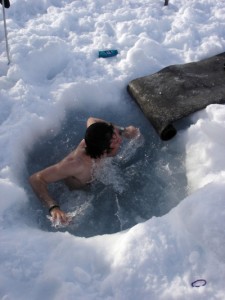 Up until today, I had never taken an ice bath. They seemed so, well, cold. So what if they help you recover? They are cold. All that ice bath abstaining ended today.